Redefining What “Success” Means in Your 30s/40s
By the time you hit your 30s and 40s, the shorthand definitions of success you grew up with, title, salary, marquee achievements, start to feel oddly thin. That’s not because those things stop mattering; it’s because the psychic cost of getting them has become clearer. For many Indians in midlife, the calculus shifts from accumulation to allocation: How much of my time, attention and energy do I want to trade for one more promotion? What parts of me have been deferred for “someday”? This is less a midlife crisis and more a reframing opportunity: to move from externally measured achievement toward internally experienced wellbeing.
Why the old metrics no longer work
If you look closely, the problem isn’t that paychecks and promotions are worthless; it’s that they are now partial signals. Income still matters, across countries, higher earnings correlate with higher self-reported life satisfaction up to a point, but the relationship is uneven and mediated by health, relationships and meaning in work. That is why studies that tie income to wellbeing stress nuance: doubling income improves life satisfaction, but so do improvements in sleep, social ties and a sense of agency at work.
Workplaces themselves have shifted under midlifers’ feet. The pandemic accelerated conversations about mental health and exposed the fragility of “always-on” success models; employers now acknowledge that high status doesn’t immunize someone from anxiety or burnout, and many employees no longer equate visibility with a sustainable life. Leaders and mid-career professionals are grappling with an inconvenient truth: the very systems that reward hustle also erode the capacity to enjoy those rewards. This is visible in corporate research and reporting that show mental health concerns cut across seniority and that meaningful work — not just money — is now a driving factor for retention and life satisfaction.
What midlife actually wants
For experienced, educated audiences, the pivot away from external validation usually centers on three interlocking desires. The first is autonomy: agency over how you spend your time, and fewer daily micro-compromises. The second is meaningfulness: the sense that the work you do or the role you play contributes to something you value. The third is psychological bandwidth — the capacity to think clearly, keep relationships in repair, and have the energy to be present. These are not vague middling goals; they are measurable levers. Research on wellbeing repeatedly shows social relationships, health and perceived control are as predictive of life satisfaction as money is. In India, conversations about midlife reinvention and career transitions illustrate how people deploy experience toward work that fits these three needs, sometimes at a lower headline salary but with far greater life dividends.
There are also gendered realities worth naming: mid-career women in India often face “the missing middle” — a structural attrition from the workforce in their 30s and 40s because of caregiving breaks, bias and stalled growth. For many, redefining success includes rebuilding professional identity on terms that acknowledge both competence and context rather than pretending both can coexist unchanged. That means redesigning roles, negotiating flexibility, or choosing new sectors where experience is valued differently. This is a systemic problem with personal solutions: individuals adapt, but organizations must also change.
How to reframe success in practice
Redefining success is an iterative, evidence-informed craft, not a once-off pep talk. Start with clarity about trade-offs: rather than asking “Do I want X?” ask “What will I have to give up to get X, and is that trade-off acceptable?” Financial planning matters here — not as a moral yardstick but as a tool for optionality. Studies from behavioral economics and life-satisfaction research remind us that financial resilience (buffer, debt control, diversification) creates more freedom to pursue lower-paying but higher-meaning paths without undue stress.
Next, treat your calendar as a truth-telling ledger. Where your time goes is where your life grows. Midlife people benefit from small but non-trivial experiments: a bounded sabbatical to test a passion, a three-month role redesign to shift responsibilities, or a commitment to weekly undistracted family time. These are empirical moves, try them, collect subjective data on energy and satisfaction, and adjust. Companies that embed employee mental-health support and autonomy see better retention and even productivity gains, which makes the case that individual and collective reframing are complementary, not opposed.
Finally, language matters. Replace “failure” with “recalibration” and “ambition” with “direction.” Cultural scripts were designed for an era of linear progress; the modern life course looks more like branching paths. Accepting that lets you swap scarcity-driven choices for curiosity-led pivots. That shift is both liberating and strategic: it reduces the cognitive load that once made every decision feel existential.
Why communities like Aprisio make the difference
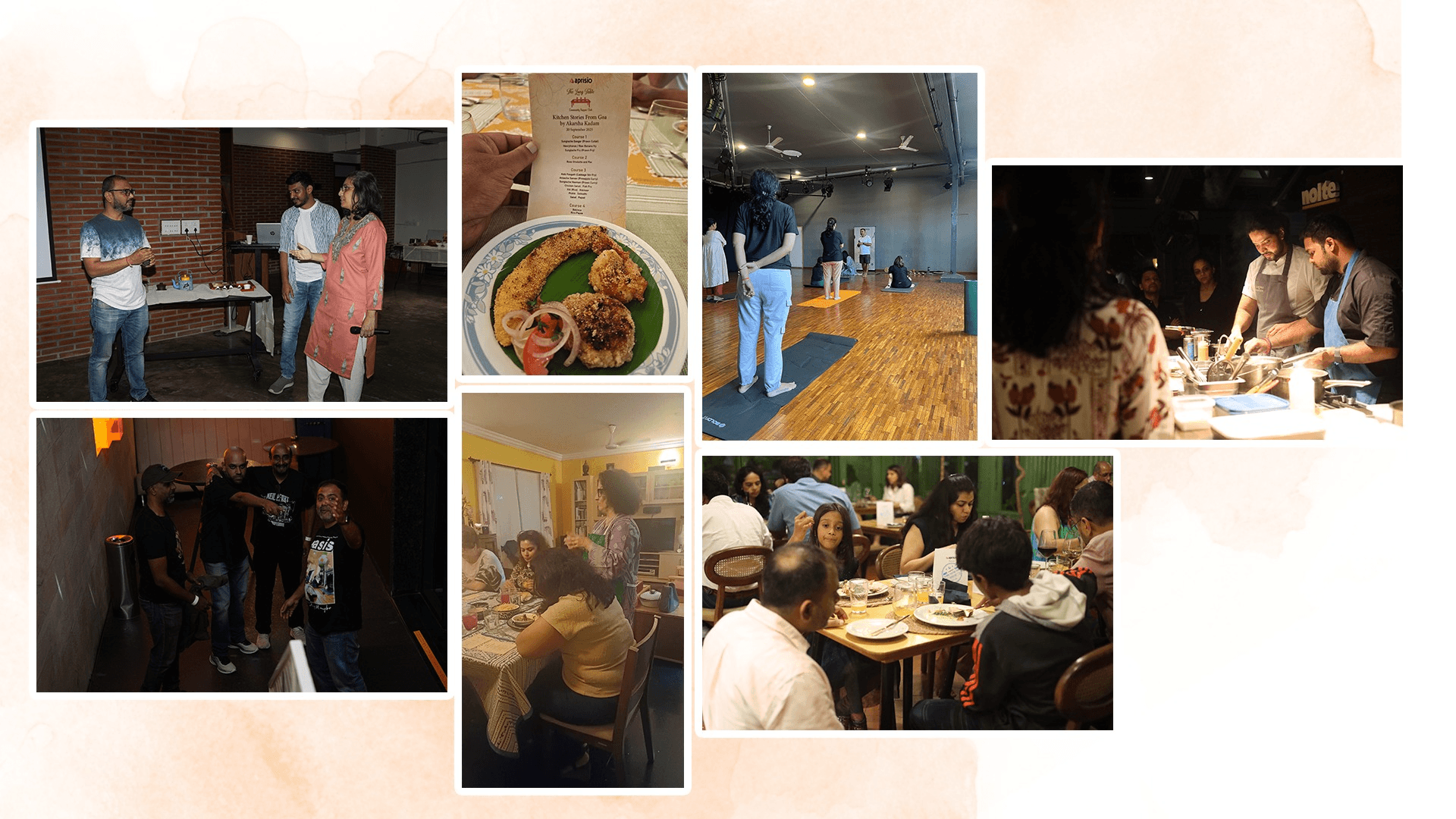
The choice to redefine success is easier when you’re not doing it alone. Midlife communities perform three essential functions: they normalize alternatives, provide practical know-how, and create social scaffolding for risk-taking. For Indians navigating the particular pressures of family expectations, age norms and career plateaus, a community like Aprisio becomes not just a comfort but an accelerant for change. Peer stories de-risk experiments; skill-sharing shortens learning curves; collective rituals shore up motivation on days when doubt creeps in.
If success at 30 or 40 is about peace of mind as much as pay, then the route to that peace runs through both interior work (financial preparedness, boundary-setting, values articulation) and exterior structures (flexible roles, supportive networks, policies that retain mid-career talent). Wellbeing is multidimensional, and so must be our strategies for it.
Conclusion
Redefining success in your 30s and 40s is not capitulation; it’s calibration. It is a refusal of the false binary that says you must choose either money or meaning. Instead, it’s a pragmatic life craft: design trade-offs consciously, invest in what preserves your mental bandwidth, and swap one-size-fits-all narratives for a portfolio of aims that include peace of mind, relationships and purposeful work. For midlifers in India — and for platforms like Aprisio that help them gather — that recalibration is the kind of long-term, high-return investment that actually looks like success when the accounting is finally honest.
Related Blogs